Showing posts with label forgiveness. Show all posts

Sunday, 19 March 2017

Unforgiveness...

Every now and then, I have one of those moments which expose the utter bankruptcy of my previous religious experience. Today, a dear friend helped to expose another one.

You see, I have been told whenever I've protested abuse and injustice at the hands of the religious that I'm just "bitter and unforgiving".

And yet, these same people who accuse me, also claim that they have done nothing wrong.

But as my friend challenged, how can forgiveness be needed - or indeed, extended - when there has been no wrong-doing?

What would there be to forgive?

So to all those people who have denied any wrong-doing towards me, and have then accused me of unforgiveness, I say this:

You cannot have your cake, and eat it too.

Either you have wronged me, and you feel justified in your claim of unforgiveness on my part;

or

you have done nothing wrong, and therefore to claim unforgiveness on my part is a nonsense.

But you can't have it both ways.

So if you want to accuse me of being unforgiving - which means there is something you have done that requires my forgiveness - please own it, and let's deal with the crap that lies between us.

I've always advocated that path.

Otherwise your accusations against me are, at best, meaningless.

Sunday, 7 February 2016

Forgiveness Is Not a Magic Bullet

Former church leader, Mark Driscoll, has recently been making headlines again. It appears he's taken one step closer to his comeback by announcing he'll be opening his brand new church, Trinity, in Phoenix. The strange thing is that there is apparently no mention in his publicity of his previous 'workplace', Mars Hill. (Considering that accounts for almost 2 decades of his working life, it seems a trifle... odd!)

Anyway, this announcement has caused quite a stir in certain circles and has yet again polarised opinions regarding his fitness to lead. There are many people (no doubt many of the bodies MD left under the Mars Hill bus) who are decrying the move. Many feel that Mr Driscoll has not yet dealt with the mess he made the last time he headed up a church.

And yet, there seem to be plenty of believers who are applauding the development, loudly proclaiming that all "true christians" should support him because... forgiveness!

Still from The Matrix

Now, I've been pondering and exploring this concept of forgiveness for a long time, but never more so since an ex-elder and his wife from my ex-church (who have since started their own church) applied to the courts for a protection order against me late last year. The application alleged that I represented such a severe threat to their safety, I should be excluded from any place they might possibly be present, including my own sons' school.

Although it didn't actually make it to court, my family and I were put through hell for two months by two 'christian leaders' who had previously been part of the abusive experience which drove me out of the institutional church.

For me, the story has had a far better outcome than I would have dreamed possible, and I am profoundly grateful for that! However, once again, the response of many christians has been to focus on the requirement for me to forgive.

Each time I've experienced abuse or injustice or wrong-doing at the hands of christians, the response has been the same. I must forgive. Yet nothing is ever said about confronting the wrong-doer, addressing injustice, or preventing the same thing happening to others.

It seems the onus is always on victim to forgive, not on the wrong-doer to repent and make amends. It is the victim who faces the consequences - being judged 'bitter and unforgiving'. Meanwhile the perpetrator walks away - free from accountability; free from consequences; free to offend again. Nothing is acknowledged, nothing dealt with, nothing changes. History just repeats itself, but with a vengeance.

Why is it that christians take this line? Why do we show ourselves so unwilling to address wrong-doing and abuse in our midst? Because the victim is a soft target? Because we don't want to pay the price of getting involved? Rarely is the response to abuse one of seeking justice for the victim. Rarely is there a call for accountability of the perpetrator.

It seems the 'christian' response to intimidation or abuse is to push for the victim to forgive; not for the perpetrator to be brought to account for their actions; not for justice to be done; not for protection against future abuse; not for preventing a repeat of the injustice.

That is why there are so many people deeply concerned about Mr Driscoll resuming his 'ministry'. Why would this man change his behaviour - this man who has never faced those he's harmed, never said 'sorry' to them, never made reparation to them? Why would we expect to see change from a man who chose to turn walk away and start a new church rather than clean up the mess he'd made of the old one? Why would he act any differently this time?

Supposedly the 'christian' response is to simply forgive and give the man another chance to damage lives, without giving a thought to the people who are still hurting from the last time. (They are seen as the problem, not him!) And yet Jesus called out the bullying, abusive behaviour of the religious leaders in his day, calling them poisonous snakes, monuments to death, even sons of hell!

He told them they tied up heavy burdens on people's backs, but wouldn't lift a finger to help them carry those burdens. A bit like telling the victim of abuse they must forgive their abuser, while refusing to address and remediate the abuse itself!

So when people like us keep talking about the injustice we suffered, the abuse we endured, the wrong we faced, do not assume it is because we are "bitter and unforgiving". When we speak about the flaws and failures in the church system do not assume it is because we refuse to "move on". When we shine a light on the darkness of christian culture do not assume it is because we are "wanting revenge".

It is because we don't want the bus to run over even more victims. We don't want bullies and abusers to continue in their ill-health. We can see that the emperor is naked and we can't pretend otherwise!

So please stop shutting us down. Assuming we haven't forgiven. Throwing the religious cliches in our face. We have legitimate grievances. Valid concerns. And ignoring the problems will not make them go away. "Just concentrating of the positive" does not diminish or justify the wrong that has been done. There is still a need for the hard work of reparation, remediation, rehabilitation, restoration, and reconstruction. Forgiveness is not a magic bullet!

Saturday, 5 December 2015

When "Forgiveness" Becomes A Trap

I recently came across an article which asked the question about what it takes for us to be able to forgive. In it, the author offers the suggestion that we need to lament - to protest the pain and darkness we are facing. Lament calls for us to be honest about our feelings instead of denying them. To refuse to "sugarcoat [our] rage" or "explain away [our] bitterness. To feel it, to own it, and to use it to protect ourselves from further harm.

As she says, "It’s easy to say we’ve forgiven if we haven’t felt our anger."

And I think that is the trap too many christians fall into. We've been taught that forgiveness is mandatory, but we also live with the unspoken pressure to keep up appearances - to look good for God. And so we fall for the lie that all we need to do is say the magic words and then everything is all ok again. We can then proceed as normal and sell our testimony of how happy and free we are.

The only trouble is, that we haven't actually dealt with the grief and anger and pain; we've simply papered over the ugliness and called it forgiveness. Despite the fact that Jesus had no issue expressing strong anger and deep grief, we've somehow equated a lack of emotion with godliness.

The article includes this quote:
In his book, The Cry of the Soul, Dan Allender says that smooth, unruffled acceptance is delusion. “For many [Christians], strong feelings are an infrequent, foreign experience. Their inner life is characterized by an inner coolness, bordering on indifference. Unfortunately, this is often mistaken for trust.”
When christians buy the lie that strong feelings are somehow 'bad', and couple it with a belief that simply saying forgiveness has happened makes it so, it creates a trap for the one who desires to be found 'acceptable'. They must continue to uphold the illusion of forgiveness and so daren't give expression to their true feelings, and yet in suppressing those feelings they will never know the freedom of real forgiveness.

If we've said we've forgiven and yet never owned our emotions, there's nowhere for us to go. We can't admit our feelings, and so we can't deal with them. We're stuck with them unless we find some way to break free from the lie.

Tragically, emotions which remain unaddressed will negatively affect both ourselves and our relationships:
"...it turns out that people who habitually suppress their emotions actually experience more negative emotions than people who suppress less. Although suppression doesn’t dampen people’s experience of negative emotions (just their expression of them) it does seem to have an adverse effect on people’s positive emotions. People who suppress more do report experiencing and expressing fewer positive emotions, and their friends agree. Being a suppressor is also associated with being more depressed, less satisfied with life, and having lower self esteem, optimism and well-being. People who suppress more also have less social support, avoid getting close to others, and are seen by peers as having fewer close relationships. Why is suppression so bad? Researchers suggest that it’s because suppressing your emotions makes you feel inauthentic, which leads to feeling worse about yourself and your relationships, the very thing you were trying to avoid." The Good and Bad of Emotion Regulation Strategies 
So maybe, it's time for christians to stop the rush to declare 'forgiveness', and take the time to actually deal with the emotional impact of whatever behaviour we've experienced which needs our forgiveness.

Monday, 29 December 2014

The Paradox of Freedom - Part 1


Many years ago I found myself, completely against my will, dealing with the loss of my marriage. I'd spent 7 years married to a man who lied and deceived seemingly without conscience, who was a master of emotional manipulation, and who acted as if the world revolved around him alone. While his regular outbursts of anger only occasionally resulted in physical abuse, it almost always ended with him breaking things - usually my things!

We'd been living in London and I had taken our baby son on a holiday back to Australia so the family could meet him. While I was there, my husband contacted me and told me he'd applied for a job back home and asked me to stay until he had an answer. After several weeks of being put off like this, I rang the company he said he'd applied to - and discovered the whole thing was a lie. When I confronted him with it, he got angry with me... again...

Now as you can probably imagine, having been treated like dirt for so long, and then abandoned with a year old son to care for, I was pretty distressed about life! I fought to save our marriage, but he just didn't want to know. Eventually, his mistress became pregnant, and I had to face the fact that my marriage was dead.

I set about trying to find my way out of the pain of betrayal and rejection I'd experienced, desperately trying to pursue God's plan for us. I knew I had to forgive my husband, but it was so hard! Some days it felt impossible.

In the midst of my struggle, I picked up a book about recovering from divorce. In it I read the most profound thing I'd ever heard: that I actually had a choice whether or not to forgive my husband!

That may sound really stupid to you, but I'd grown up with a christianity that amounted to a set of rules, a standard that 'must' be reached. If you were a christian, you had to forgive. Being a christian was synonymous with 'doing the right thing'. And doing 'the wrong thing' meant facing the shame and censure of family and church.

But here was this book, written by christians, declaring that I had a choice! I was free to forgive or not - it was entirely up to me! The book did explain that there were certain realities that went with whatever I chose, but nonetheless, I did have a choice.

This was a totally new and revolutionary idea to me! I wasn't being coerced into anything - I was being set free.

And the paradox was that once I realised I had the freedom not to forgive, I found that I wanted to forgive him. Not because it was 'the right thing to do', but because I wanted to be free of the anger and pain that was crippling me.

I'll be honest - it still took time and effort on my part, and there were still days when I wanted him to be hurt as badly as he'd hurt me, but I was doing this for the sake of freedom not because someone was telling me I 'had to'.

I had a choice and I was free!


Friday, 12 December 2014

Father Forgive Them...

I was angry last night!

The big, green, Incredible Hulk type of anger.

This morning it's the quietly sickened and disgusted type.

Why?

Because friends of mine are hurting badly - torn to pieces by religion.

Because they are just one more statistic - victims of an abusive institution erroneously called 'church'.

Because religious leaders seem to think it's actually ok to throw their brothers and sisters under the bus.

Because they don't seem to care about the damage they inflict as long as they stay in power.

Because they use their position to denounce family members, in an attempt to control the narrative.

Because they can't seem to understand that the words of judgement they preach from their pulpits apply equally to themselves.

Because they ignore the words of Jesus and lord it over their brothers and sisters.

Because members of 'the body' seem to think this is normal and so they don't stand up and shout, "NO! STOP! ENOUGH!"


And because it's Just. Plain. Wrong!


Friday, 25 July 2014

Just Get Over It!

Rotten ecards

Imagine you were part of a circle of friends, many of whom you'd known for a long time. You are close, you often spend time together in each other's company. Everyone tells you how much they love you and value you. You feel happy and accepted.

Now imagine that things start to change. In subtle, and not-so-subtle, ways you start to feel pressured to conform to expectations you never agreed to. To comply with other people's dictates. Eventually, things become more overt and these friends start to slap you around.

You object.

You might even fight back.

But they club together. And one day, they gang up and beat you up so badly that you can't even get back on your feet. Bones are broken. Flesh is bruised.

You plead for justice. For your wounds to be tended. For them to love you once again.

And they turn and say, "Oh, we're sorry that you feel hurt."

You look at them incredulously.

They continue, "We've said sorry and we feel ok now. We've moved on. You need to do the same. Just forgive us and get over it."

You protest.

So they turn away. They can't be around someone so bitter and unforgiving!

Does this sound at all familiar? Have you experienced this type of behaviour?

I ask this because something I read the other day reminded me that this was what happened to me. I came across across this article in a Newsletter written by Leslie Vernick. The context is domestic abuse, but the principle applies to any type of abusive situation.
After having said, “I’m sorry” often the destructive spouse believes he or she is now entitled to amnesty, forgiveness, and full restoration of marital privileges without ever having to make amends, suffer long-term consequences, or work hard to repair and rebuild trust. Sometimes we collude with such unrealistic and unbiblical thinking pressuring the injured spouse to forgive and reconcile. 
But if she’s not yet ready, or refuses to grant amnesty, or restore full marital privileges until she sees evidence of repentance, we often start to label her as ungracious, ungodly, rebellious, and hard-hearted. Instead of being supported and validated for the pain she’s in, she now feels pressured, scolded, shamed or scared for her “unbiblical” stand or refusal to fully reconcile.
Thank God, I'm in a much better place these days!

But what if you're not? What if you are being pressured to forgive and move on - to "just get over it"?

If that is where you are, I want to share the truth with you.

It is not unforgiving to refuse to trust someone who has betrayed your trust. You are not being bitter if you insist that words are meaningless without the actions to back them up.

You are not ungodly or unrighteous if you hold out for evidence of repentance! You are WISE!

Tuesday, 3 June 2014

Christians, Stop Shooting our Wounded

By Suzannah Paul

We talked about sex in the summer camp dining hall. It was staff orientation, and we unpacked consent, abuse, and how virginity is a lousy measure of the purity of one’s heart before God. We deconstructed bad metaphors, exploring the significance of the incarnation and the imago Dei.
She found me later, a young woman who’d been through hell and back. Her courage blew me away.
“Thank you for seeing me,” she said, eyes shining. “Sometimes I feel so invisible.”

WE LOVE TO TALK ON THINGS WE DON’T KNOW ABOUT

Our sisters’ and brothers’ blood cries out from the ground. Others bear unfading scars from sexual, psychological, physical, emotional, and spiritual abuses, suffered even at the hands of those claiming Christ’s name.
We may not have hearts to understand, but we serve up solutions all the same… Continue reading here.


Friday, 11 April 2014

Magic Words Syndrome

I recently re-read a couple of the emails (or nasty-grams, as I call them) I received from one of the board members of my old church. It was quite interesting to engage with them now, without the incredible pain of betrayal and judgement I felt at the time they were first sent. It feels like they are full of justification on his part and judgement against me. None of the issues I have raised were ever addressed, I just received a continual barrage of words telling me how much I was the one in the wrong.

Apparently I was living in the past, causing division, gossiping to others, slandering the leadership, using cruel words and accusations, refusing to walk in the power of reconciliation and anyway, I "gave as good as I got". The ones who'd abused me were walking in their freedom and I was still (by my own choice) walking in bondage.

The very last email correspondence was from last year, when I had tried a last-ditch effort to find a way of bringing about reconciliation between us. The letter started by telling me how little it had cost me to meet with 'D' (even though he had nominated a time exactly when he knew I needed to be collecting my children from school), but how much incredible trouble he had gone to.

What it articulated to me was how important he was with all his important ministry and everything, and how unimportant I was because I'm just a trouble maker, and how grateful I should be that he bothered to actually meet with me at all. He assured me that he was willing to pay such an immense cost because he thought 'reconciliation' would be the outcome. The trouble was that by reconciliation, I can only assume he meant I'd finally shut up and stop making trouble for him.

It seems I was in grave error right from the start because my "welcome [of him] was icy cold" and my husband's was "only slightly warmer". Seriously! What did he expect? I felt completely unsafe with this man and it was only my desperate belief that there had to be a better way than we'd found so far that propelled me into meeting with him at all. I'd felt sick to the pit of my stomach at the thought of that meeting because of all I'd suffered at his hands. He'd already made it quite clear that elder J was his golden boy, and that the only part I had to play was in submitting to J's "godly leadership" (although I would have described it more in terms of abusive usurper-ship, but then I'm the evil one of the piece). When I'd objected to the abuse I'd experienced, he'd made it crystal clear by his nasty-grams that the blame was mine alone.

This was also the man who had preached for 3 weeks in a row(!) warning the church against me and whose judgement against me had caused my brother and his family to sever all contact with me. I did explain this to him, but he rejected any responsibility in this matter.

In revisiting his written words, two things became painfully clear.

The first one was the evidence of what I've come to call 'magic words syndrome'. The way it works is that in dealing with an issue, you listen to the one you are 'counselling', agree that they believe in what they say they are struggling with, get them to say some magic words, and hey presto, everything's all ok.

The trouble with this approach is that it doesn't actually deal with any of the very real, existing problems. It doesn't deal with the emotional damage that has been inflicted, neither does it address the relational issues that have caused so much devastation. You repeat some formula words as if they have some sort of magic power, say forgiveness has happened and then equate that forgiveness with actual reconciliation.

This leaves those who have devastated you by their behaviour completely free to continue their ill treatment of you, because everything's been dealt with, and it places the onus on you to smile and just keep accepting the abuse. And woe betide you if you find yourself still wanting to deal with things, because that just proves that you are bitter and unforgiving; unable to move on (like everyone else has!) and rejecting the reconciliation that's been decreed to have happened - as if reconciliation can ever be a unilateral event imposed on another!!!

The second point, I will address in my next post, Silencing is Abuse.

Thursday, 10 April 2014

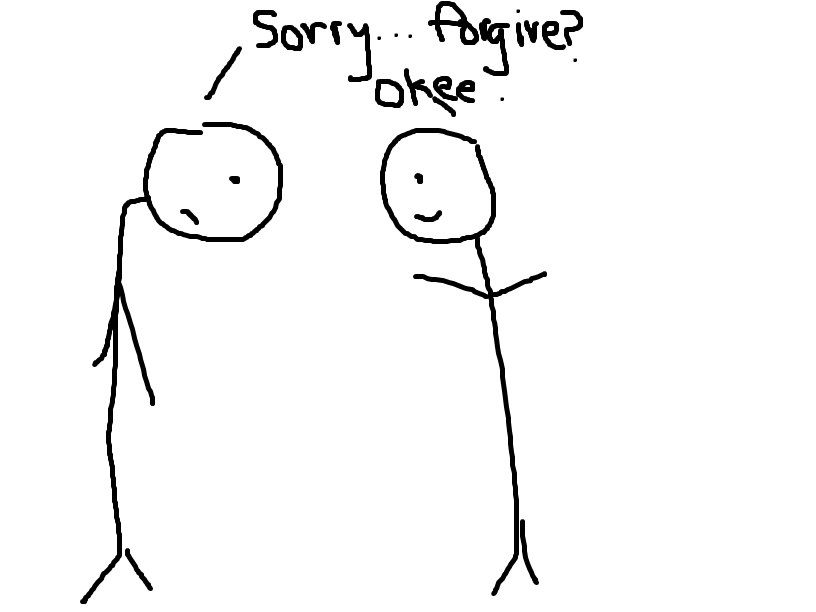
A Better Way to Say Sorry

By joellen @ cuppacocoa (This is not just for kids - there are many adults who could use this advice, too!)

“Say sorry to your brother.”

“But he’s the one who–”

“Say it!” you insist, an edge of warning in your voice.

He huffs, rolls his eyes to the side and says flatly, “Sorry.”

“Say it like you mean it,” you demand.

“Sorrrrry,” he repeats, dragging out the word slowly with bulging eyes and dripping insincerity.

You sigh in defeat and turn to #2, “Now tell him you forgive him.”

“But he doesn’t even mean it!”

“Just say it!”

“iforgiveyou…” he mutters, looking down to the side dejectedly.

“Now be nice to each other.”

Harumphy silence. Keep reading here...